
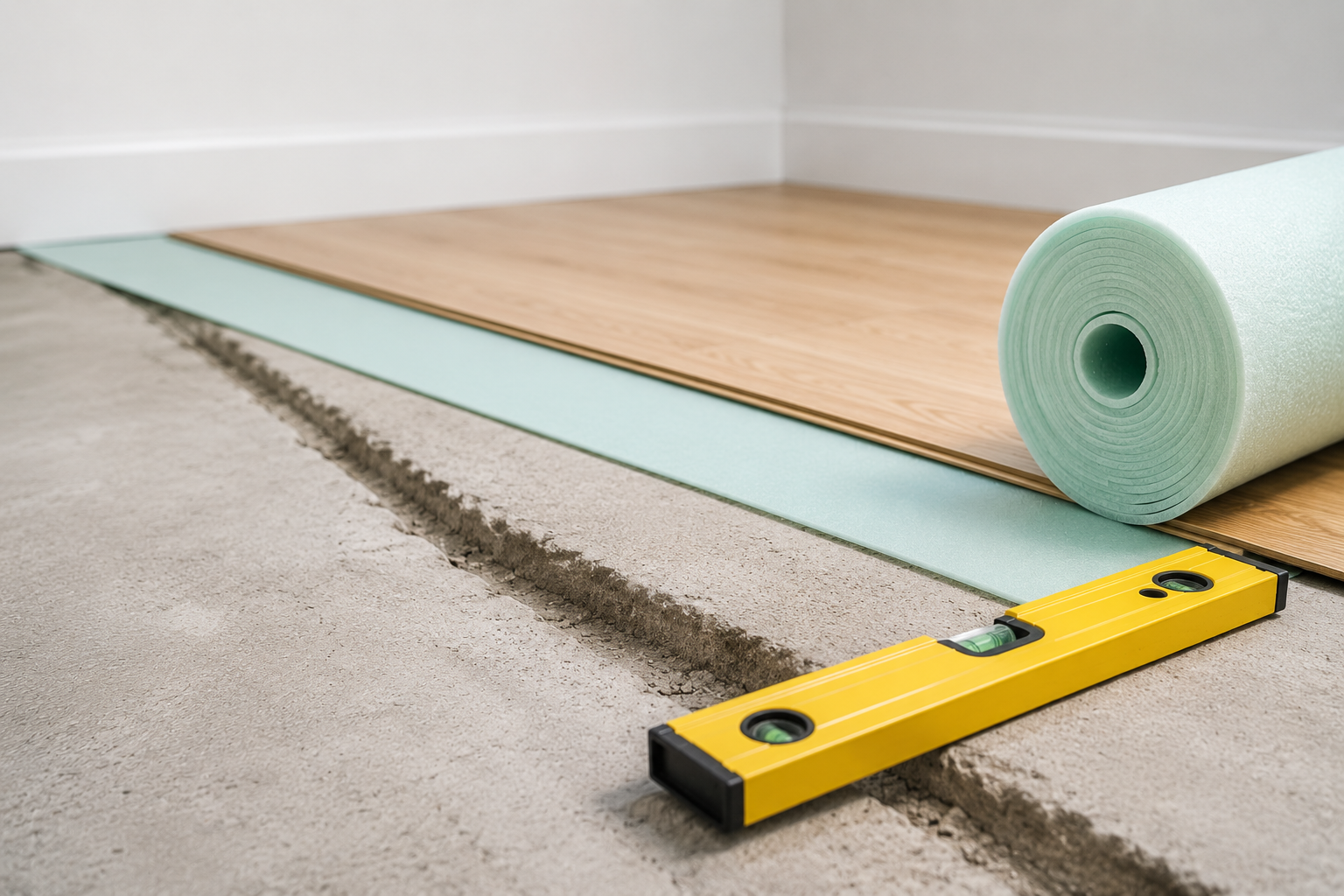
Underlay plays an important part in many flooring installations, but it is often expected to do a job it was never designed to do. A thicker or softer underlay may make a floor feel more comfortable, reduce noise and accommodate very small surface imperfections, but it cannot properly correct an uneven or unstable subfloor.
If a floor has noticeable dips, raised areas, loose boards or changes in level, these problems normally need to be addressed before the new flooring is installed. Covering them with underlay may temporarily disguise the issue, but it does not remove the cause and can lead to problems with the finished floor.
What Is the Difference Between Uneven and Unlevel?
The terms “uneven” and “unlevel” are often used interchangeably, but they do not always mean the same thing.
An uneven floor has localised imperfections such as ridges, dips, raised joints or damaged areas. These can prevent the flooring from being properly supported.
An unlevel floor may slope gradually from one side of the room to the other. A floor does not necessarily have to be perfectly level for every type of flooring, but it generally needs to be sufficiently flat, sound and suitable for the product being installed.
This distinction matters because a gradual slope may not affect an installation, while a smaller but sudden dip beneath a click joint could cause movement and eventual damage.
The acceptable amount of variation depends on the flooring manufacturer and product. Installation instructions should therefore always be checked rather than relying on one tolerance for every floor.
What Is Underlay Actually Designed to Do?
Depending on the product, underlay can provide:
- Acoustic reduction
- Additional comfort underfoot
- Thermal insulation
- Support for a floating floor
- Moisture protection when an appropriate vapour barrier is included
- Minor accommodation of small surface imperfections
It is the final point that often causes confusion. Some underlays are promoted as being suitable for slightly irregular subfloors, but that does not mean they can fill substantial dips or level a badly prepared floor.
Manufacturer guidance may permit a particular underlay to accommodate limited irregularities in certain circumstances. For example, Quick-Step recommends its Thermolevel underlay for some uneven existing timber floors. However, the timber must still meet the manufacturer’s other requirements and remain stable, sufficiently ventilated and suitable for installation.
Underlay should be viewed as part of a complete flooring system, not as a replacement for proper preparation.
Can Thick Underlay Level a Floor?
No. A thicker underlay does not turn an uneven subfloor into a flat one.
Soft underlay compresses when weight is applied. If there is a dip underneath the floor, the underlay may initially bridge or disguise it, but it will not provide the same firm support as a properly prepared base.
Using underlay that is thicker or softer than the flooring manufacturer permits can create excessive vertical movement. With laminate, engineered wood and click LVT, this movement can place unnecessary strain on the locking joints.
Doubling up underlay is also generally unsuitable unless the flooring manufacturer specifically approves that system. Some products already have an attached backing and are designed to be fitted without an additional layer. Amtico Click Smart, for example, has an integrated acoustic backing and does not require separate underlay.
The correct underlay should always be chosen according to the flooring manufacturer’s instructions, rather than simply selecting the thickest product available.
What Can Happen If Flooring Is Laid Over an Uneven Subfloor?
The exact problem will depend on the type of flooring, but possible consequences include:
Movement and Bouncing
A floating floor may flex when walked on if it is not evenly supported. Some slight movement can be normal with certain floating installations, but obvious bouncing or rocking may indicate that the subfloor is not sufficiently flat.
Damaged Click Joints
Repeated movement can place pressure on the locking system. Over time, joints may separate, lift or become damaged.
Quick-Step advises that unevenness beneath vinyl flooring can cause visible marks and gaps and states that the subfloor should be stable and firmly fixed. It should not be soft, damaged or loosely laid.
Noisy Flooring
Hollow sounds, clicking and creaking may develop where the flooring moves against the underlay or adjoining boards.
Visible Imperfections
Thin and flexible floor coverings can reflect imperfections from beneath. This is sometimes known as telegraphing, where ridges, joints or other defects become visible through the finished flooring.
Premature Wear
Movement and poor support can cause concentrated pressure in certain areas, potentially reducing the working life of the flooring.
Can Underlay Fix an Uneven Floor Beneath Laminate?
Laminate is normally installed as a floating floor over an approved underlay. The underlay helps support the system, reduce sound and accommodate very minor imperfections, but the subfloor must still comply with the laminate manufacturer’s flatness requirements.
A small surface texture is very different from a deep dip, raised floorboard or pronounced ridge. Those defects should be repaired before the laminate is fitted.
The correct solution may involve:
- Securing loose floorboards
- Replacing damaged boards
- Sanding or planing isolated high areas
- Repairing low or damaged sections
- Installing a suitable flooring-grade overlay
- Applying an appropriate smoothing system where the substrate and manufacturer permit it
The new laminate should not simply be laid over a moving or significantly uneven base.
Can Underlay Fix an Uneven Floor Beneath Click LVT?
Click LVT is installed as a floating system, but that does not mean the floor underneath can be ignored.
Rigid click products may cope with limited irregularity better than some thinner products, but every range still has installation limits. Quick-Step specifically notes that although some of its click vinyl products are suitable for more irregular surfaces, they still have limitations and the relevant installation instructions must be followed.
An uneven base can leave click LVT unsupported, causing movement and strain around the joints. Adding a separate underlay is not automatically the answer, particularly when the product already has an integrated backing or the manufacturer prohibits additional underlay.
Can Underlay Be Used Beneath Glue-Down LVT?
Traditional glue-down LVT is not normally installed over a loose roll of underlay. It is bonded to a properly prepared substrate using a compatible adhesive system.
Amtico states that its glued LVT requires an even, dry and clean installation surface. Its installation guidance also requires the base to be hard, smooth, clean, dry and free from defects.
Because glue-down LVT follows the surface beneath it closely, floor preparation is particularly important. Ridges, joints and trowel marks may show through the finished flooring if the base is not prepared to the required standard.
An appropriate smoothing compound is commonly used to create a suitable surface. F. Ball explains that smoothing compounds can fill indentations and imperfections to provide a smooth foundation for LVT.
What About Carpet Underlay?
Carpet underlay can make a carpet feel softer and may reduce how noticeable very small imperfections feel underfoot. However, it still cannot structurally repair an uneven floor.
Loose, damaged or excessively uneven floorboards should be repaired before carpet is installed. Raised fixings and sharp edges can damage the carpet or underlay, while substantial dips may still be felt after fitting.
Carpet may visually disguise more than hard flooring because it is soft and flexible, but disguising an imperfection is not the same as correcting it.
How Should an Uneven Concrete Floor Be Prepared?
The correct preparation depends on the condition of the concrete or screed and the flooring being installed.
Possible work can include:
- Removing contamination, weak material and old residues
- Mechanically preparing the surface where required
- Grinding down isolated high points
- Repairing cracks or damaged areas with an appropriate repair product
- Applying the correct primer
- Using a compatible smoothing compound
- Checking moisture levels and installing an appropriate moisture-control system where required
A smoothing compound should not be selected solely because the floor looks uneven. The existing base, depth required, moisture condition, adhesive residues and proposed floor covering all influence which preparation system is suitable.
- Ball states that uneven and irregular surfaces should be suitably prepared withan appropriate smoothingcompound before resilient flooring is bonded.
How Should an Uneven Timber Floor Be Prepared?
Timber subfloors require a different approach because movement, ventilation and structural condition must be considered.
Preparation may involve:
- Securing loose or squeaking boards
- Replacing damaged or decayed timber
- Correcting protruding fixings
- Sanding or planing raised edges
- Repairing isolated imperfections
- Installing suitable flooring-grade plywood or another approved overlay
- Preparing board joints where required by the installation system
- Balladvisesthat worn or uneven floorboards may need to be replaced, sanded, planed or patch filled before further preparation takes place.
Overlaying a timber floor does not automatically correct serious movement or structural problems. The original floor must first be sufficiently sound and secure.
How Can You Check Whether a Floor Is Flat Enough?
A flooring installer will usually assess the surface with a suitable straightedge and inspect the floor for:
- Gaps beneath the straightedge
- Raised areas
- Sudden changes in level
- Loose or moving sections
- Damaged screed or boards
- Cracks and weak areas
- Moisture concerns
- Contamination that could affect adhesives
It is important to check the installation instructions for the exact flooring being fitted. For example, Quick-Step gives a flatness requirement for some wood flooring of no irregularities greater than 4mm over two metres and 1mm over 20cm. That is a product-specific example, not a universal rule for every laminate, LVT or wood floor.
Can You Correct a Floor by Applying More Adhesive?
Adhesive should not normally be used as a substitute for a suitable repair or smoothing product.
Flooring adhesives are designed to bond the floor covering to the prepared substrate. Applying excessive adhesive to fill depressions can affect drying, create an unstable bed and prevent the adhesive from performing as intended.
Low areas should instead be treated using a preparation product compatible with the substrate, flooring and adhesive system.
When Is an Uneven Floor a Structural Concern?
Some uneven floors are caused by surface imperfections, while others may indicate movement or a structural problem.
Further investigation may be needed when there is:
- Significant or worsening settlement
- Noticeable movement underfoot
- Rotten or damaged timber
- Cracking that continues to develop
- Damp affecting the subfloor
- Large changes in level
- Signs that joists or supporting structures have moved
A flooring installer can assess whether the surface is suitable for installation, but structural concerns may need to be investigated by an appropriately qualified building professional.
The Final Answer
Underlay may accommodate very small imperfections when the chosen flooring and underlay manufacturers allow it, but it cannot properly fix an uneven floor.
It will not reliably correct deep dips, raised joints, loose boards, damaged screed or significant changes in level. Attempting to hide these problems with thick or additional underlay can leave the flooring unsupported and may cause movement, noise, opening joints or premature failure.
The safest approach is to have the existing floor assessed before installation. At Floors2U, the condition of the subfloor can be checked as part of the measuring and quotation process, allowing any necessary preparation to be identified before the new flooring is fitted.
A well-prepared subfloor may not be the most visible part of a finished installation, but it is one of the most important factors in achieving a floor that looks right and performs properly for years to come.