
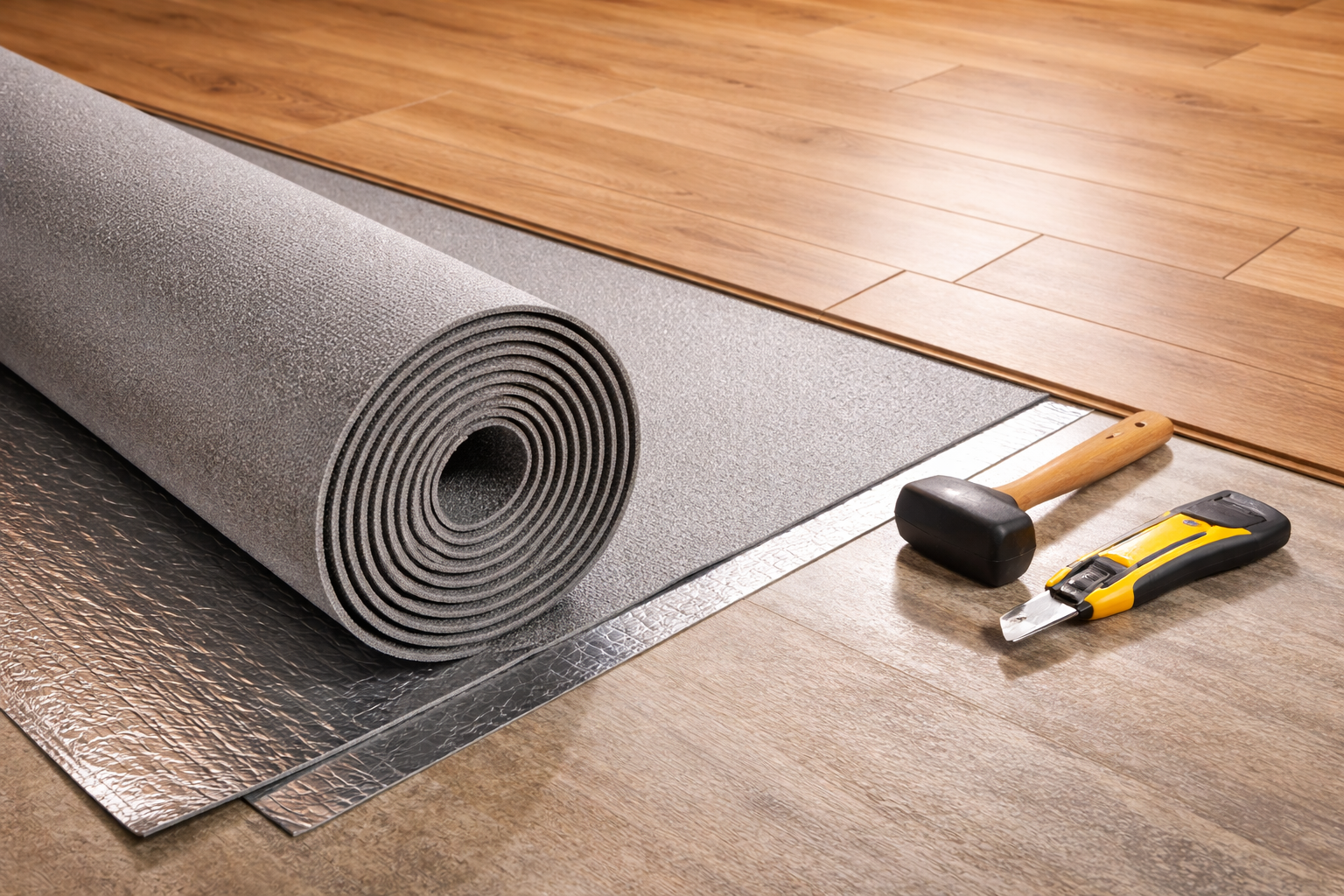
It is one of those questions that comes up all the time, especially when people are trying to keep costs down or work out what they can and cannot skip.
Do you really need underlay for laminate or carpet?
In most cases, yes, you do.
But the reason is not just because it is the “normal” way of doing it. Underlay actually plays a big part in how the floor feels, how it performs, how long it lasts, and whether the finished job feels solid or cheap. A lot of problems people blame on the flooring itself can actually come from the wrong underlay, poor underlay, or no underlay at all.
The truth is, underlay is not just an extra. It is part of the floor system.
Why underlay matters in the first place
When people look at flooring, they usually focus on the visible finish. They look at the carpet colour, the laminate style, the plank size, the texture, the price. That is the part they can see every day.
What they do not always think about is what is going underneath it.
That hidden layer can affect comfort, sound, warmth, durability and even how the floor wears over time. If the base under the floor is wrong, the whole thing can feel off no matter how good the top layer is.
A decent underlay can help:
- cushion the floor underfoot
- absorb impact
- reduce noise
- improve insulation
- support the flooring properly
- help the floor last longer
- improve the feel of the whole room
That is why skipping it usually ends up being a false economy.
Do you need underlay under laminate
Yes, in the vast majority of laminate installations, you do.
Laminate is a floating floor. That means it is not normally fixed directly down to the subfloor. Instead, the boards click together and sit on top of an underlay layer. That underlay is there for a reason.
Without it, laminate can feel hard, noisy and unstable. Every footstep can sound sharper. Small imperfections in the subfloor can become more noticeable. The floor may not feel as solid as it should, and over time that can put more stress on the locking system.
Underlay for laminate helps by giving the floor a proper base to sit on. It smooths out very minor variations, helps with sound reduction, and gives a bit of support and cushioning without being too soft.
That last bit matters. People sometimes think thicker automatically means better, but that is not always true. If an underlay is too soft or too spongy for laminate, it can cause movement in the boards. Too much movement can lead to joints weakening, boards separating, or the floor feeling bouncy.
So yes, laminate needs underlay, but it also needs the right type of underlay.
What happens if you lay laminate without underlay
A few things can happen, and none of them are good.
First, the floor will usually sound harsher. Laminate already has a harder feel than carpet, and without underlay that effect is even more obvious. Every step can sound hollow or sharp, especially in larger rooms.
Second, the floor can feel less forgiving underfoot. Even if the laminate itself looks fine, it can feel cheap to walk on if there is nothing proper underneath it.
Third, the boards can suffer more stress. Laminate click systems are designed with a proper installation method in mind. If you remove part of that system, you increase the risk of wear at the joints.
If the subfloor has minor imperfections, underlay can help manage those small variations. Without it, those imperfections can transfer through more noticeably. That can affect both how the floor feels and how it performs over time.
It is worth saying as well that underlay does not fix a bad subfloor. If the floor underneath is uneven, damaged or unstable, underlay is not there to hide that. Proper prep still comes first. But once the floor is ready, underlay is still an important part of the installation.
Do you need underlay under carpet
Yes, again, in most cases you do.
Carpet without underlay is a different world to carpet with proper underlay. Even a decent carpet can feel flat and disappointing if it is fitted without that support underneath. On the other hand, a good underlay can improve the feel of a carpet massively.
This is why underlay matters so much with carpet:
It adds comfort. That is the obvious one. The carpet feels softer and more cushioned underfoot.
It helps with insulation. Rooms can feel warmer and more comfortable when carpet is fitted with the right underlay.
It improves sound reduction. This makes a noticeable difference upstairs, on stairs, landings and bedrooms.
It can help the carpet last longer. Underlay helps absorb the impact from foot traffic instead of all that pressure going straight into the carpet backing.
A lot of people assume the carpet itself is what gives that soft, quality feel. In reality, underlay is doing a lot of the work.
What happens if you fit carpet without underlay
You can do it in some cases, but that does not mean you should.
Without underlay, carpet usually feels thinner, harder and less comfortable. It can also wear out faster because there is less support underneath it to absorb the pressure of everyday use.
The backing of the carpet takes more of a beating. Over time, that can affect the appearance and lifespan of the floor. Traffic areas may flatten sooner. The carpet can feel more tired more quickly.
You also lose a lot of the warmth and sound benefits that people often want from carpet in the first place.
So while it might save money at the start, it can make the finished job feel lower quality and shorten the life of the carpet.
Is all underlay the same
Not even close.
This is where people can get caught out. They hear “underlay” and think it is one product category where anything will do. It is not.
Laminate underlay and carpet underlay are not interchangeable. They are made for different flooring types and different performance needs.
Laminate underlay needs to work with a floating floor system. It cannot be too soft or too thick, because that can cause movement and stress on the joints.
Carpet underlay is about support, comfort and wear. The right choice depends on the room, the carpet type, and how the room is going to be used.
For example, a bedroom might suit a different underlay feel than a busy staircase or landing. A heavy traffic area needs something suitable for that level of use, not just the cheapest roll available.
This is why choosing underlay based on price alone is a mistake. Cheap underlay can drag down a good floor. A better underlay can lift the whole job.
Can you save money by buying a cheaper underlay
You can save money upfront, yes. But that does not always mean you are saving money overall.
Cheap underlay often means less support, less durability, less comfort and poorer performance. That can show in the way the floor feels on day one, but it also tends to show more over time.
With laminate, cheap underlay can make the floor feel noisier and less solid.
With carpet, cheap underlay can make a new carpet feel underwhelming and can contribute to it wearing out sooner.
The underlay is not the glamorous part of the floor, so people are tempted to cut there. But it is usually one of the most important places not to go too cheap.
Does underlay make up for a poor subfloor
No, and this is an important point.
Underlay is not there to fix an uneven, loose or badly prepared subfloor. That is a separate issue.
If a subfloor is not right, it needs to be dealt with properly before the flooring goes down. For laminate, that may mean levelling or correcting issues first. For carpet, it may mean making sure the floor is suitable, smooth and sound.
Trying to use underlay as a shortcut for poor prep usually leads to problems later on.
A properly prepared floor with the right underlay is the goal. Not one or the other.
So, do you really need underlay for laminate or carpet
Yes, in most situations you do.
For laminate, it helps support the floating floor, improves sound and comfort, and helps the floor perform the way it should.
For carpet, it adds comfort, insulation, sound reduction and helps the carpet last longer.
Skipping underlay might look like an easy way to cut costs, but it usually ends up affecting the feel, quality and durability of the finished job. It is one of those things that people often do not notice when it is there, but they definitely notice when it is missing or wrong.
What it comes down to
If you are spending money on new flooring, it makes sense to do the full job properly.
A good floor is not just about the surface you see. It is also about what is underneath, how it is prepared, and whether all the parts work together.
That is why underlay matters.
It is not just an optional extra thrown on the quote for the sake of it. In most laminate and carpet installations, it is a key part of getting the floor right.
If you are unsure what underlay is right for your room, the safest thing is to ask before anything is ordered. It is far easier to choose the right setup at the start than to deal with a floor that feels wrong once it is down.