
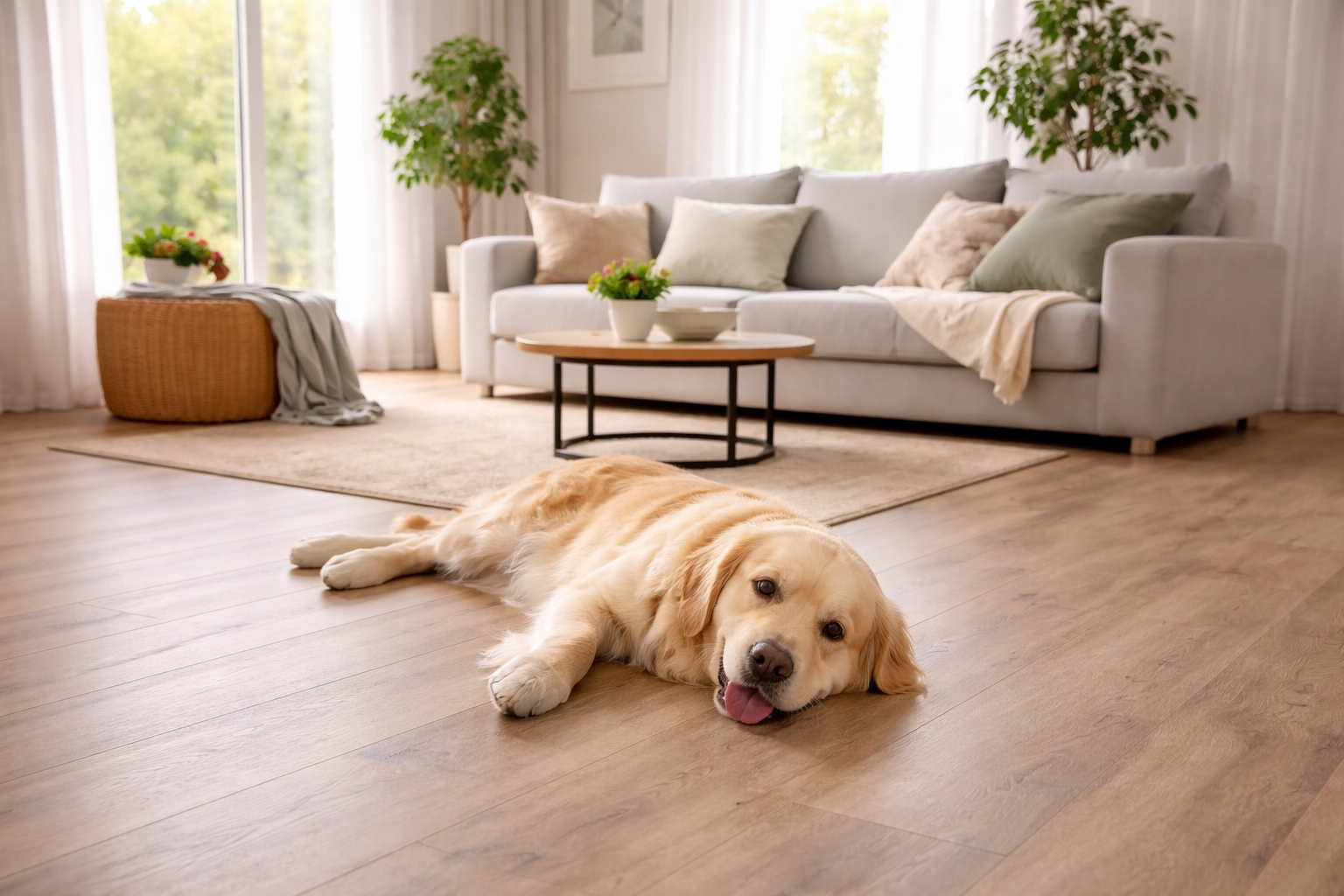
Choosing flooring when you’ve got pets isn’t just about appearance. It needs to handle claws, dirt, moisture and daily wear without quickly starting to show damage. What works well in a quiet household can struggle once it’s exposed to constant movement and mess.
Some flooring types are marketed as durable but don’t always hold up in real conditions. Others, which might not seem as premium at first glance, can perform far better over time. The key is understanding how each option behaves in everyday use rather than just how it looks when it’s first installed.
LVT – A Practical All-Round Option
For most homes with pets, LVT is one of the more reliable choices.
It’s fully waterproof, which makes it far more forgiving when it comes to spills, wet paws or accidents. Unlike materials that absorb moisture or react to it, LVT stays stable and doesn’t swell or warp when exposed to water.
It also deals with wear more effectively than many people expect. The protective surface layer is designed to take regular impact, and while no flooring is completely immune to scratching, it generally holds up well under normal pet activity.
Another factor that makes a difference is how it feels underfoot. Compared to harder, smoother surfaces, LVT usually provides a bit more grip. That reduces slipping and makes it easier for pets to move around comfortably, particularly in open areas where they’re more active.
Maintenance is straightforward as well. Day-to-day cleaning doesn’t require anything complicated, and it’s easier to keep it looking consistent over time compared to more absorbent materials.
Laminate – Durable but Limited by Moisture
laminate flooring is often considered as a cost-effective option and can work in certain situations, but it does come with some limitations in pet households.
The surface itself is fairly tough and can handle general wear reasonably well. However, the main weakness is how it deals with moisture. Even water-resistant versions aren’t fully waterproof, so if liquid gets into the joints or beneath the boards, it can lead to swelling and long-term damage.
It can also be quite smooth, which affects traction. Pets may find it harder to grip, especially when turning or moving quickly, and over time that can contribute to uneven wear in specific areas.
Laminate can still be a suitable choice in lower-risk environments, but it tends to require more care and attention to prevent issues developing.
Carpet – Comfortable but Higher Maintenance
carpet is often chosen for comfort and warmth, and it can still have a place in certain areas of the home.
It provides a softer surface, which can be more comfortable for pets to rest on, and it can help reduce noise compared to hard flooring. However, it does come with a trade-off in terms of maintenance.
Carpet fibres are more likely to trap dirt, hair and odours, and even with regular cleaning it can be harder to keep it looking fresh. Stains can also be more difficult to deal with, particularly if they soak through into the underlay.
Because of this, carpet is usually better suited to spaces with less exposure to heavy use, rather than main living areas where pets are constantly moving in and out.
Real Wood – High-End Appearance, More Care Required
There’s no denying that real wood offers a strong visual finish, but it’s not always the most practical option when pets are involved.
Wood is naturally more sensitive to both impact and moisture. Scratches can appear over time, particularly in areas with regular movement, and exposure to water can cause staining or changes in the material.
While it can be refinished in the future, that process isn’t always straightforward and may not be something people want to deal with regularly.
In homes where pets are active and the flooring is exposed to daily wear, real wood often requires a level of maintenance that doesn’t suit every household.
What Makes Flooring Pet-Friendly
When looking at different options, a few factors tend to have the biggest impact over time.
Durability is important, but it’s not just about how hard the surface is. It’s about how well it handles repeated use without showing visible wear too quickly.
Moisture resistance is another key factor. Even small amounts of water, if they’re frequent enough, can cause issues with certain materials.
Grip also plays a role that’s often overlooked. Surfaces that are too smooth can make movement difficult for pets, particularly in larger open spaces.
Finally, ease of maintenance makes a difference day to day. Flooring that’s simple to clean and doesn’t hold onto dirt or odours will generally be more practical in the long run.
Making the Right Choice
There isn’t a single option that suits every home, but some materials are clearly more suited to the demands that come with pets.
LVT tends to offer the most balanced performance, combining durability, moisture resistance and ease of maintenance. Laminate can work in the right conditions but has limitations, particularly around water exposure. Carpet is better used selectively, while real wood, although visually appealing, often requires more upkeep than many expect.
In most cases, seeing materials in person and understanding how they perform in a real environment makes the decision much easier.
This is something that often becomes clearer when comparing different options side by side, rather than relying purely on descriptions or images. At Floors-2u, the range of materials available reflects how varied different homes and requirements can be, which is why no single type of flooring is always the right answer.