
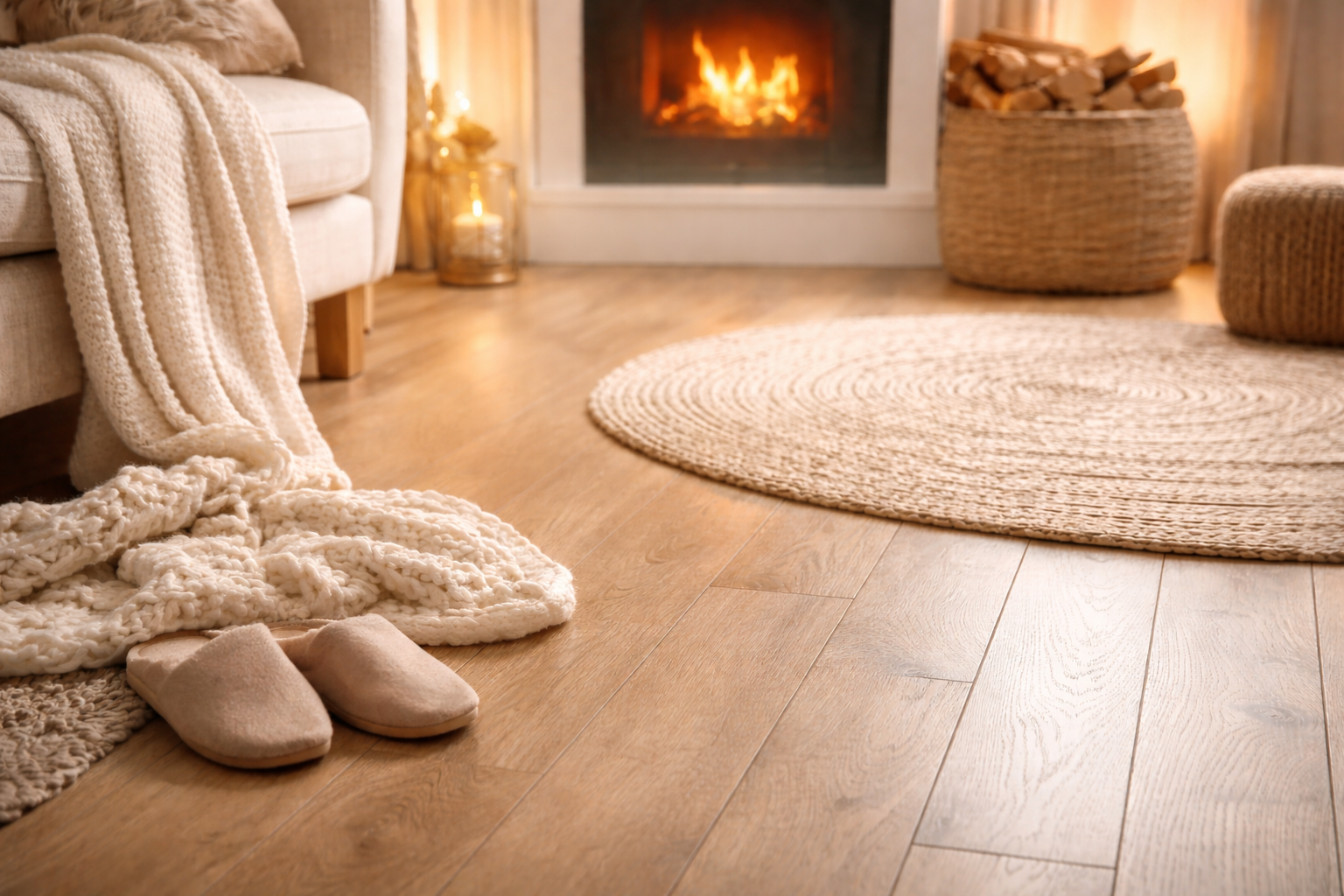
Cold floors are one of those things people just put up with, but they shouldn’t. If a room feels cold underfoot, it usually means heat is escaping or not being retained properly at floor level. That has a knock-on effect on comfort, energy use, and how the whole space feels day to day.
The type of flooring you choose plays a bigger role in this than most people realise.
This isn’t about what looks warm. It’s about what actually feels warm when you walk on it, and what helps keep heat in the room rather than letting it disappear into the subfloor.
What Actually Makes a Floor Feel Warm
There are two main factors:
- Thermal insulation
Some materials hold heat better than others. These feel warmer because they don’t pull heat away from your body as quickly. - Surface feel(thermal conductivity)
Dense materials like stone or tile feel cold because they draw heat out of your feet fast. Softer or more insulated materials do the opposite.
The warmest floors combine both — they retain heat and don’t feel cold on contact.
Carpet: Still the Warmest Option Overall
If warmth is the priority, nothing really beats carpet.
It’s soft, it traps air, and it acts as a proper insulating layer. That means less heat escaping through the floor and a noticeably warmer feel underfoot, especially first thing in the morning.
Add a decent quality underlay underneath and it makes a big difference. You’re not just getting comfort, you’re improving how the room holds heat.
Where it works best:
- Bedrooms
- Living rooms
- Upstairs areas
Where it’s less ideal:
- Kitchens
- High moisture areas
If you’ve got a room that always feels cold no matter what, carpet is usually the quickest way to fix it without overthinking things.
Real Wood Flooring: Naturally Warmer Than You Think
A lot of people assume wood feels cold, but real wood floors actually sit somewhere in the middle.
They don’t hold heat like carpet, but they don’t pull heat away as aggressively as tile or stone either. The natural structure of timber gives it a more balanced feel underfoot.
The key thing with wood is what’s underneath it. If it’s installed over a poorly insulated subfloor, it’ll feel colder. If it’s properly prepped and installed, it can feel surprisingly warm, especially in living spaces.
Another benefit is how it reacts to room temperature. Once the room warms up, the wood holds that temperature fairly well.
Where it works best:
- Living areas
- Hallways
- Open plan spaces
Laminate Flooring: Depends on What’s Under It
Laminate flooring on its own isn’t particularly warm. It’s a relatively thin material, so most of the warmth (or cold) comes from what’s underneath.
This is where underlay becomes important.
A good quality underlay can:
- Add insulation
- Reduce heat loss
- Improve overall comfort underfoot
Cheap underlay = cold floor
Proper underlay = completely different feel
So if you’re going with laminate in a cold home, the focus shouldn’t just be the boards — it should be the full build-up.
Where it works best:
- Bedrooms
- Living rooms
- Budget-conscious installs
LVT: Warmer Than Tile, Cooler Than Carpet
LVT (Luxury Vinyl Tile) sits in a similar category to laminate but tends to feel slightly warmer underfoot.
It doesn’t get as cold as tiles, and because it’s more flexible, it doesn’t have that harsh cold feel when you step on it. That said, it’s still not an insulating material.
Again, the subfloor and any underlay or backing layer play a big role here.
One advantage of LVT is that it works well with underfloor heating. If you’re planning that, LVT becomes a much warmer option overall because it transfers heat efficiently.
Where it works best:
- Kitchens
- Hallways
- Open-plan spaces
Subfloor Matters More Than You Think
You can have the best flooring in the world, but if the subfloor is cold, damp or poorly insulated, the finished result will still feel cold.
Common issues:
- Solid concrete with no insulation
- Drafts coming through suspended floors
- No moisture barrier or insulation layer
Fixing the base often makes more difference than changing the surface.
That might include:
- Adding insulation between joists
- Using a proper underlay system
- Applying a damp proof layer if needed
This is the part most people skip, and it’s usually why floors still feel cold after being replaced.
Underfloor Heating Changes Everything
If warmth is a serious issue, underfloor heating is the one thing that overrides most of the above.
Once heat is coming from below:
- Hard floors feel warm instead of cold
- Temperature is more consistent
- Rooms feel comfortable without relying on radiators
Some materials work better with it than others:
- LVT and laminate transfer heat well
- Wood works but needs correct specification
- Carpet can reduce efficiency depending on thickness
It’s not always necessary, but in genuinely cold homes, it solves the root problem rather than just masking it.
Choosing What Actually Works
There isn’t a single “best” option — it depends on the room and what you’re trying to fix.
Quick guide:
- If comfort and warmth are priority → carpet
- If you want a balance of warmth and durability → real wood
- If you’re on a budget but still want decent performance → laminate with good underlay
- If you want something practical that doesn’t feel cold → LVT
The mistake people make is choosing based purely on look, then wondering why the room still feels cold.
Final Point Worth Knowing
Warmth isn’t just about the flooring itself. It’s about how everything works together — the material, the underlay, the subfloor, and how the room is used.
Most cold floor issues we see aren’t caused by the surface finish alone. It’s usually a combination of poor prep, wrong materials for the space, or missing insulation underneath.
Get those bits right, and even a naturally cooler material can feel comfortable. Get them wrong, and even the warmest option won’t perform properly.