
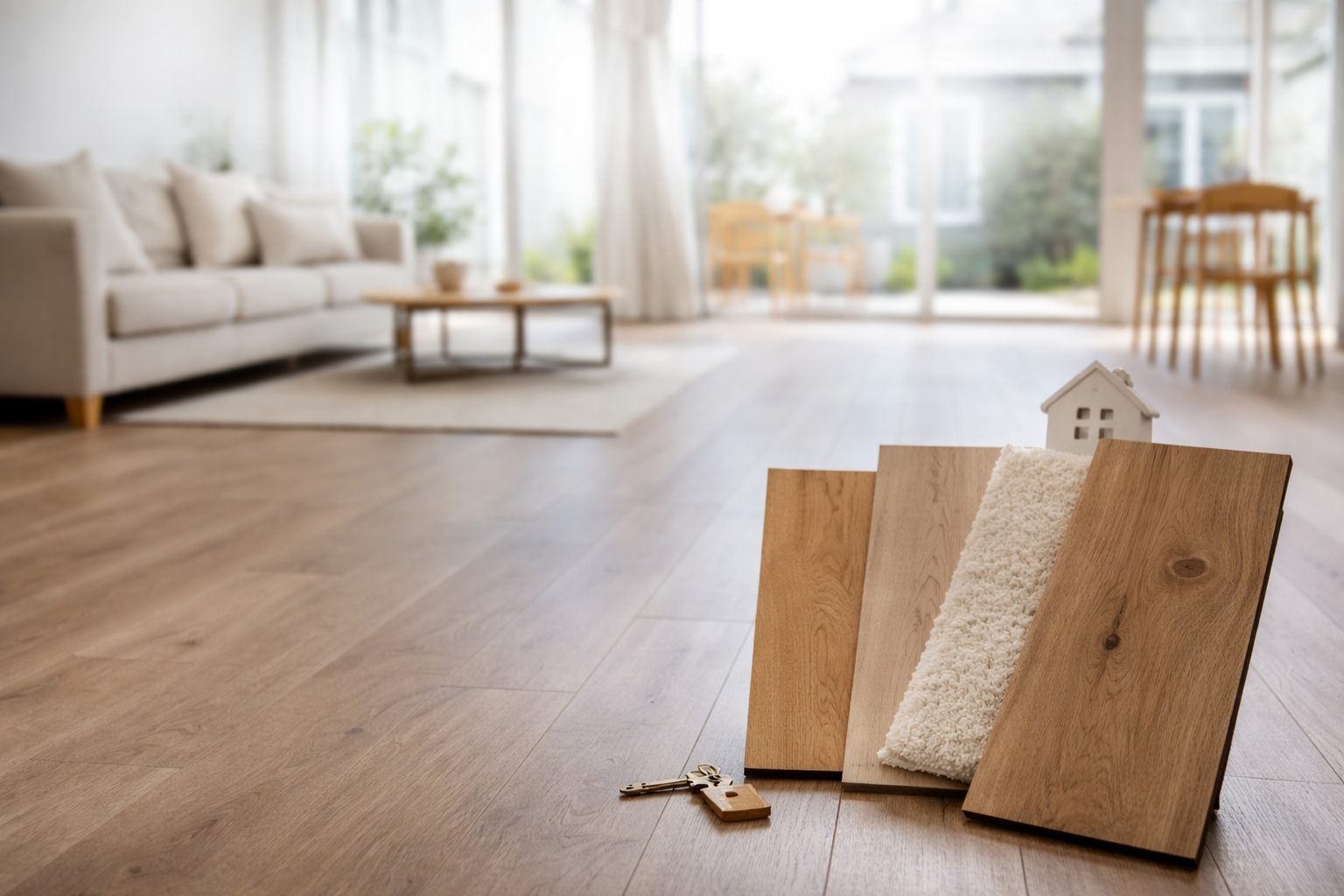
When people think about increasing the value of a property, flooring often gets overlooked. Kitchens and bathrooms usually take priority, but flooring runs through every room and has a bigger impact than most realise.
It’s one of the first things people notice when they walk in. If it looks worn, outdated or poorly fitted, it immediately brings down the feel of the entire space. On the other hand, when flooring looks clean, consistent and well installed, it can make a property feel ready to move into.
That difference alone can affect how people view the property and what they’re willing to pay.
The important thing to understand is that adding value isn’t just about choosing the most expensive option. It’s about choosing something that looks right, performs well over time and suits how the space is actually used.
Why Flooring Has Such a Big Impact
Flooring covers a large percentage of what you see in any room. Unlike furniture or decoration, it’s not something you can easily change or ignore. It forms the base of the entire space.
If a floor looks tired, uneven or mismatched, it creates the impression that the property needs work. Buyers may not always say it directly, but it affects how they feel when they walk around.
Even small issues like lifting edges, visible gaps or worn areas can make a bigger impression than people expect. These details suggest a lack of care or underlying problems, even if everything else is in good condition.
In contrast, a clean and consistent floor creates a sense of order. It makes the space feel looked after and easier to live in. That can have a direct influence on buyer confidence.
LVT – The Best All-Round Option
Luxury Vinyl Tile (LVT) has become one of the most popular flooring choices in recent years, particularly in homes where durability and practicality matter.
One of its main advantages is that it handles everyday use very well. It’s fully waterproof, which makes it suitable for kitchens, hallways and other high-traffic areas where spills and moisture are common. Unlike materials that react to water, LVT remains stable and doesn’t swell or warp.
It also holds up well under regular wear. The surface is designed to take daily use, and while no floor is completely immune to marks, LVT tends to maintain its appearance better than many alternatives.
Visually, it offers a clean and modern finish. It can replicate wood or stone styles without the upkeep those materials require. When installed properly, it creates a consistent look throughout the property, which is something buyers tend to respond to.
Because of that balance between appearance and performance, LVT often adds value not by being the most expensive option, but by being one of the most practical.
Laminate – A Cost-Effective Improvement
Laminate flooring can still improve a property, especially where existing floors are outdated or damaged.
Modern laminate has come a long way in terms of design. It can provide a neat, updated finish that lifts the overall look of a room. For properties that need a refresh without a large budget, it can be a sensible choice.
However, it does have limitations. It isn’t fully waterproof, and over time it can be affected by moisture if liquid gets into the joints. In busy areas or homes with pets, this can lead to swelling or visible wear.
Because of this, laminate tends to add value best in lower-risk areas such as living rooms and bedrooms, rather than across an entire property.
Carpet – Comfort Over Long-Term Value
Carpet still has its place, particularly in bedrooms where comfort and warmth are more important than durability.
New carpet can make a room feel softer and more inviting. It can also help with noise reduction, which is useful in certain types of properties.
However, it doesn’t usually add as much value as hard flooring in main areas. Carpet wears more visibly over time, can hold dirt and odours, and is often seen as something that may need replacing sooner.
For that reason, it’s generally more effective when used selectively rather than throughout the entire home.
Real Wood – High-End Look, With Trade-Offs
Real wood flooring is often seen as the premium option. It can add a strong visual finish and, in the right setting, it can increase the appeal of a property.
However, it comes with trade-offs. Wood is more sensitive to moisture and can be affected by changes in temperature and humidity. It’s also more prone to scratches and dents in busy households.
While it can be refinished, that process takes time and isn’t always something people want to deal with regularly.
In higher-end or lower-traffic environments, real wood can work well. In more active homes, it often requires a level of maintenance that doesn’t suit everyone.
Consistency Across the Property
One of the biggest factors in how flooring affects value is consistency.
A property with multiple different flooring types can feel disjointed, even if each material is good on its own. Changes between rooms can break up the flow of the space and make it feel smaller or less considered.
Using the same flooring across key areas, or at least keeping styles aligned, creates a more unified look. This makes the property feel larger and more cohesive, which tends to appeal more to buyers.
Consistency often has a bigger impact than the specific material chosen.
Installation Quality Matters More Than Material
The quality of the installation plays a major role in how flooring is perceived.
A well-installed mid-range floor will almost always add more value than a poorly fitted high-end one. Issues such as uneven surfaces, visible joins or poorly finished edges can stand out immediately.
These kinds of problems don’t just affect appearance. They also suggest that the floor may not last, which can put buyers off.
Good preparation and proper installation make a significant difference to both the look and performance of the floor.
Making the Right Choice
There isn’t a single flooring option that suits every property. The right choice depends on how the space is used, the level of traffic it sees and the condition of the existing floor.
In most cases, flooring adds value when it improves how the property feels overall. Clean, practical and well-finished spaces tend to leave a stronger impression than materials chosen purely for appearance.
For many homes, LVT provides the best balance between durability, appearance and ease of maintenance. Laminate can work as a cost-effective improvement in the right areas, while carpet is better suited to bedrooms. Real wood can add value in certain settings but isn’t always the most practical choice.
Seeing materials in person and understanding how they perform in real conditions often makes the decision much clearer. What looks good in a sample doesn’t always reflect how it will perform over time.
Ultimately, flooring adds value when it makes a property feel complete, functional and ready to live in.